“I give him everything, and he could not care less”
The contribution is not taken in and comes back to the giver. Do not increase it: work out why stopping the giving is harder than getting burned.
Home / Love
Love · Kaizen
“The Flow of Love: An Owner’s Manual” is an engineer’s book about what happens between two people: what contact is made of, how to check whether it is matched, and how individual matched actions add up to a flow of love.
95 pages · free · also in Russian
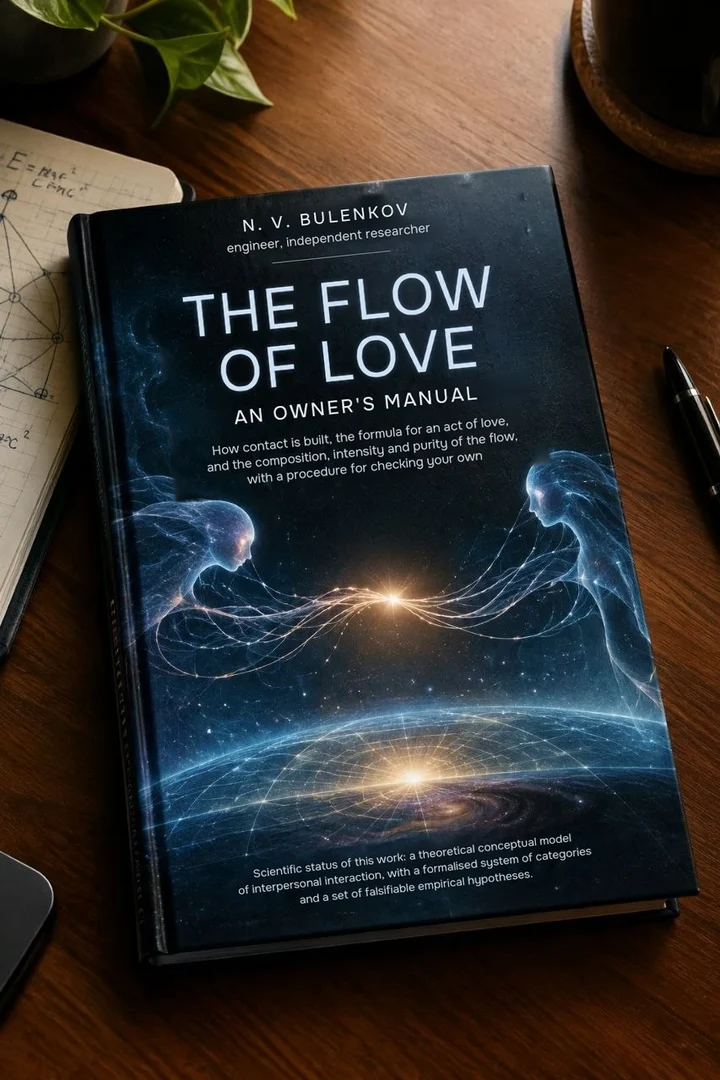
Phrases from the book’s “Common faults” table. The book is laid out like technical documentation: what is observed, the probable cause, what to check, the first action.
The contribution is not taken in and comes back to the giver. Do not increase it: work out why stopping the giving is harder than getting burned.
Both are on “give”, and reception is closed on both sides. One side switches to receiving: turning the volume up makes it worse.
Both are waiting to receive, and the channel is empty. Somebody starts transmitting, usually whoever noticed.
The intensity of the flow fell, with no event behind it. Count the episodes over the last month and over the last year, and arrange contacts deliberately: it will not restore itself.
What is given is not what is needed. Ask directly what the other person needs, and change band instead of increasing effort.
Matching with no way out: resonant overload. Restore your other connections; that is not a betrayal of the present bond.
“For thirty years I asked people what love is, and the answers I got were different in kind.” One person says “kindness,” the second says “passion,” the third says “never betraying me.” And so they live: two people under one roof, both loving, both spending every day proving to the other that the other loves wrongly.
The book shows that the definitions differ not in content but in coordinate: a feeling is a row of the matrix, a deed is a column. Arguing about which matters more is like arguing whether the street or the house number matters more in an address.
“An act of love is when both of them are doing something for each other, what they are doing fits together, both want it, both consent to it, and nobody outside forbids it.”
One act is not yet love. What matters is what repeats: the flow. It has a composition, an intensity and a purity, the share of time taken by acts of love. That makes improvement visible, and so Kaizen becomes possible.
The longest study of happiness
Since 1938, Harvard has followed 724 men, university students and teenagers from poor Boston neighborhoods, and now more than 1,300 of their children. Those most satisfied with their relationships at 50 were the healthiest at 80, a better predictor of old age than cholesterol.
The study’s directors call it “social fitness”: relationships, like the body, need regular exercise. That is Kaizen: small steps, repeated.
Lagom
Just right
“A purity of one is unreachable and is not the goal,” the author writes. Good things are not endless: they have a peak, after which continuing yields less and costs more. It is best to leave soon after the peak, not when you are tired of it.
It is a theoretical model with a set of testable hypotheses. The work was carried out outside any institution and has not been peer-reviewed. The psychology and sociology part (literature review and source checks) was prepared together with the language model Claude (Anthropic), as the book states openly.
Comments in the book are open. If you are a researcher, a psychologist or simply a careful reader, help develop the theory.
“Finding a suitable person is a task of minimising friction. Building a flow is a task of matched interaction.” For the first task there is “Six of Six”: six questions about the essentials (where to live, how to live together, how to earn, what to believe), and you see at once whom you will agree with without a fight.
It works when you meet in person: scan a QR code and see the match instantly. The app is in Russian; other languages are in development.
If there is violence in the relationship (you are hit, threatened, cannot leave, or a child nearby is suffering), set the analysis aside. You need help: find a helpline in your country.
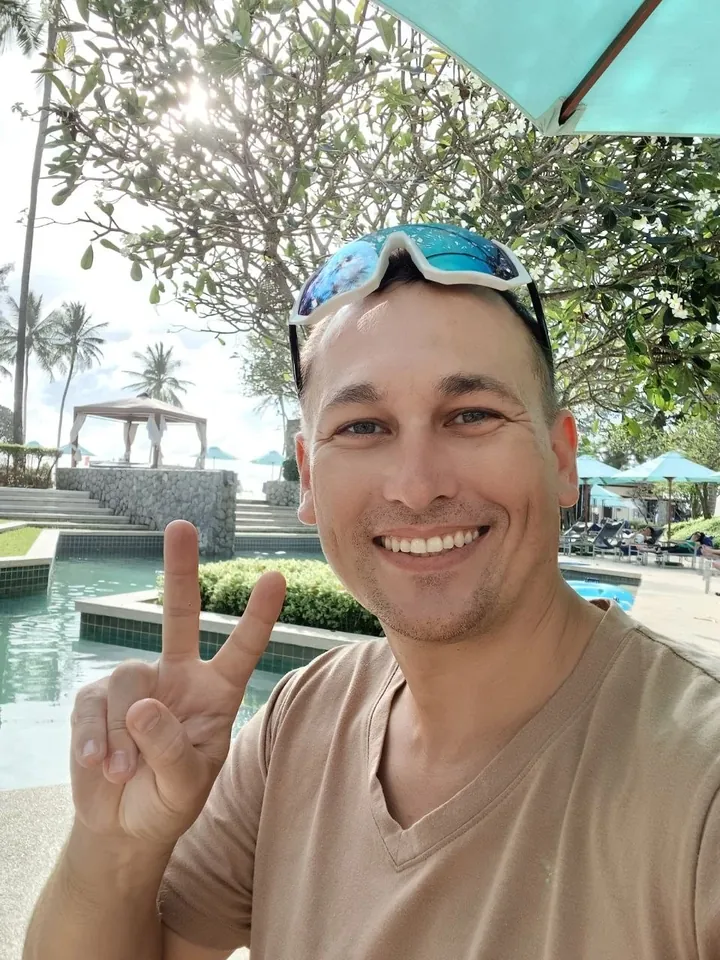
The author
A communications engineer by training (Bauman Moscow State Technical University, radio electronics) and an independent researcher. A communications engineer asks three questions about any channel: What is going down it? Is it matched? Is this band allowed? The book grew out of those three questions.
Download the book and find your case in the table of common faults.