“I don’t have enough money”
Start with a cheap mistake: in the game it costs points, not savings.
Home / Money
Money · Blue Ocean
In most markets everyone fights for the same customers, and the water turns red. A blue ocean is a space where there is no need to fight: you create new demand instead of taking someone else's. You can learn it without risking your own money.
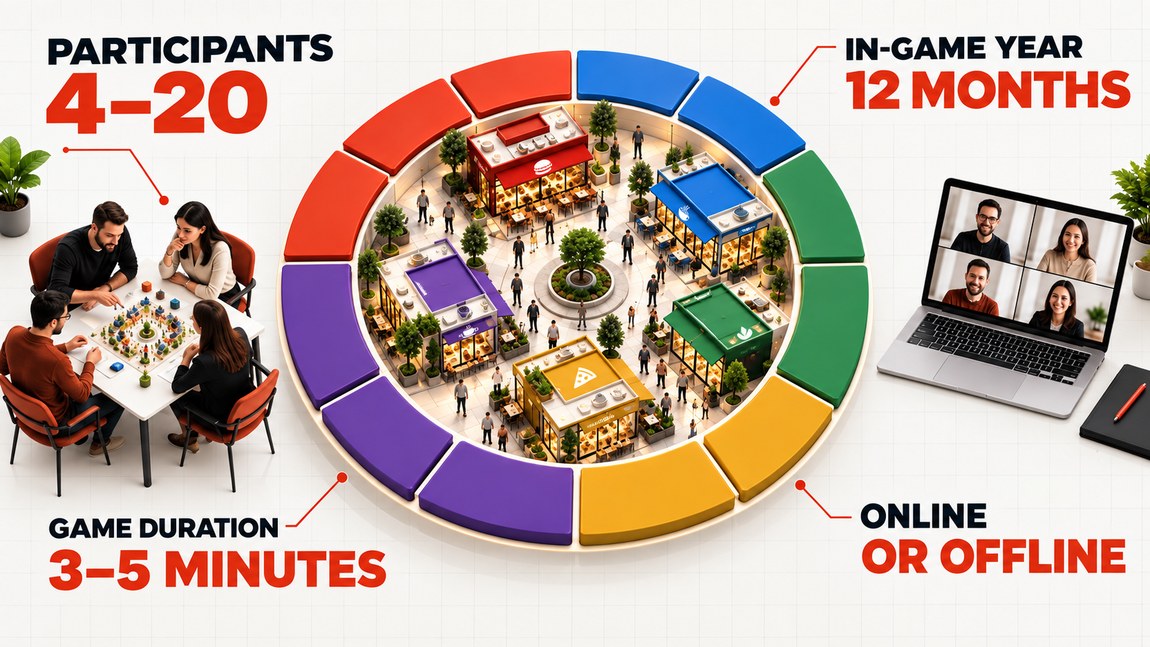
Start with a cheap mistake: in the game it costs points, not savings.
See the market through an owner’s eyes: where money comes from and why there is never enough.
Go from opening day to a cash gap in one evening, before you invest your own money.
Freedom starts with understanding what to sell, to whom and at what price.
When everyone has the same AI consultant, the winner is the one who can play against live people.
When money runs short, all attention goes into getting through today. Researchers call it the tunnel vision of scarcity: lack eats up the capacity you need to plan (Mullainathan and Shafir, “Scarcity”).
This is where forced labor and the fight over the same pie come from. The way out is not necessarily to quit: first you need to learn to see the market differently.
Kim and Mauborgne, “Blue Ocean Strategy”: a red ocean is an existing market where competitors split the demand; a blue ocean is a new space where competition stops mattering.
The key is value innovation: raise the value for the customer and cut costs at the same time. The goal is not to beat your neighbor but to make fighting pointless.
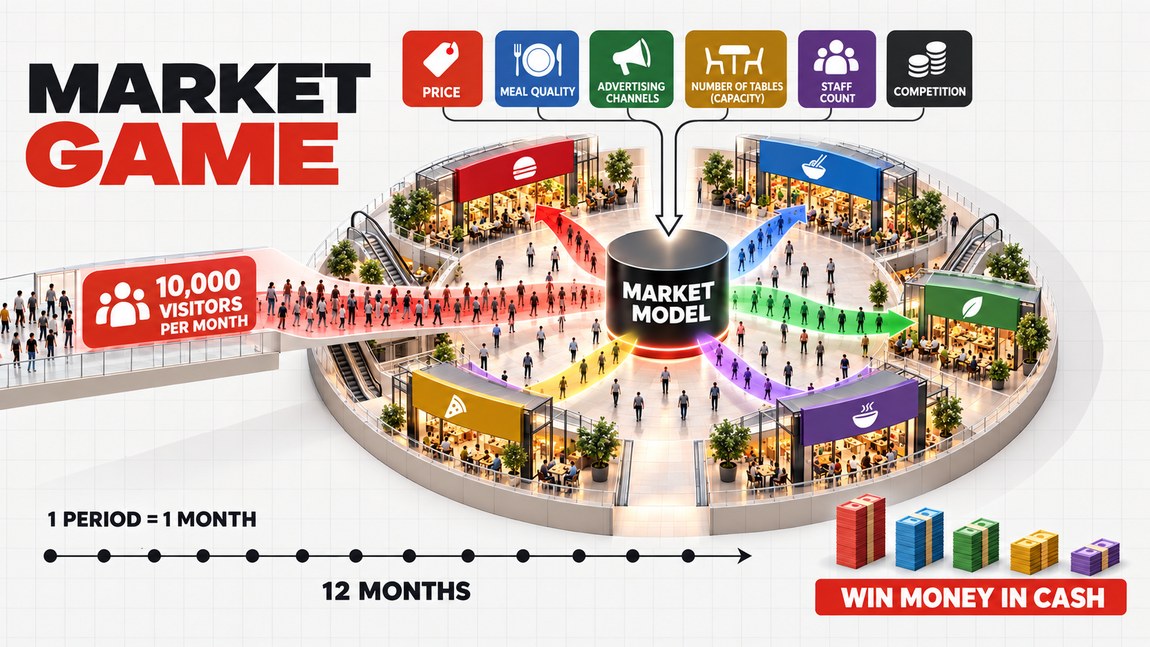
Market Game
The first game is almost always a red ocean: prices go down, the last money goes into ads, a cash gap follows. After a few games, teams notice that raising quality and keeping a fair price pays off, and then everyone earns more.
Version 5.0 builds this into the model: demand grows both with quality and with lower prices. The blue ocean does not appear at the press of a button; it comes from the balance of every player’s decisions. That is play and learn: the lesson is lived, not read.
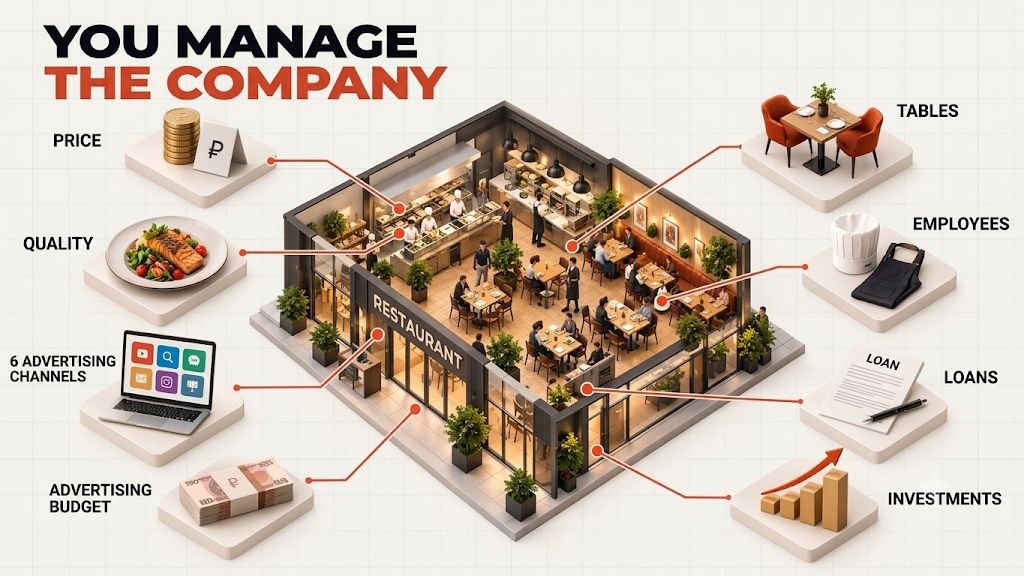
Each turn a team sets its price, invests in quality, picks advertising, adds tables, hires staff and takes loans. The market model splits the customers, and the team gets a report: revenue, costs, profit, cash on hand.
League 12 · Start
Learn the cost of typical mistakes before you pay for them with your own money.
Pick a gameLeague 24 · Growth
Up to 10 employees and up to $1M in annual revenue. Test your strategy over a longer run.
Pick a gameLeague 36 · Elite
A strategy session with an extended debrief for the owner.
Pick a gamePrices and upcoming dates are on the game’s site; the schedule is shown in your time zone.
Lagom
Just right
The Swedish “lagom” means not too little and not too much. Money matters while it covers basic needs and gives freedom of choice; beyond that each extra dollar gives less and less (Jebb et al., 2018). People who always look for the maximum are on average less happy than those who settle for good enough (Schwartz et al., 2002). And in the game it is not the lowest or the highest price that wins, but balance.

The author of the game
An engineer (Bauman Moscow State Technical University) with more than twenty years in sales, management and business development. Created “Deal Simulator”, named the most useful training tool for realtors in Russia in 2014 by MAUA. Sales director at Like Centre (Ayaz Shabutdinov) in 2017–2019, head of the training centre of the “33 Slona” project at Mail.ru Group in 2019–2021.
Before you pay for mistakes with your own money.